

Part 2 of our Demat 2.0 series · Written as of 19 September 2026. This is a new pilot and details are still coming out, so we will update this page as they do.
When SEBI and RBI launched the Demat 2.0 pilot in September 2026, the word “tokenised” did most of the damage. Headlines put it next to pictures of Bitcoin. Readers asked whether their demat account was about to change, whether they needed a wallet, and whether India had quietly allowed crypto trading.
None of that is what happened. Below are the confusions we have seen most often, and what the available material actually says.
We label each answer so you can see how firm it is:
- Confirmed — stated by SEBI or RBI, or in the FAQs as reported in the press.
- Reported — press coverage only, not official material.
- Our reading — our interpretation, clearly marked as such.
1“It’s a cryptocurrency”
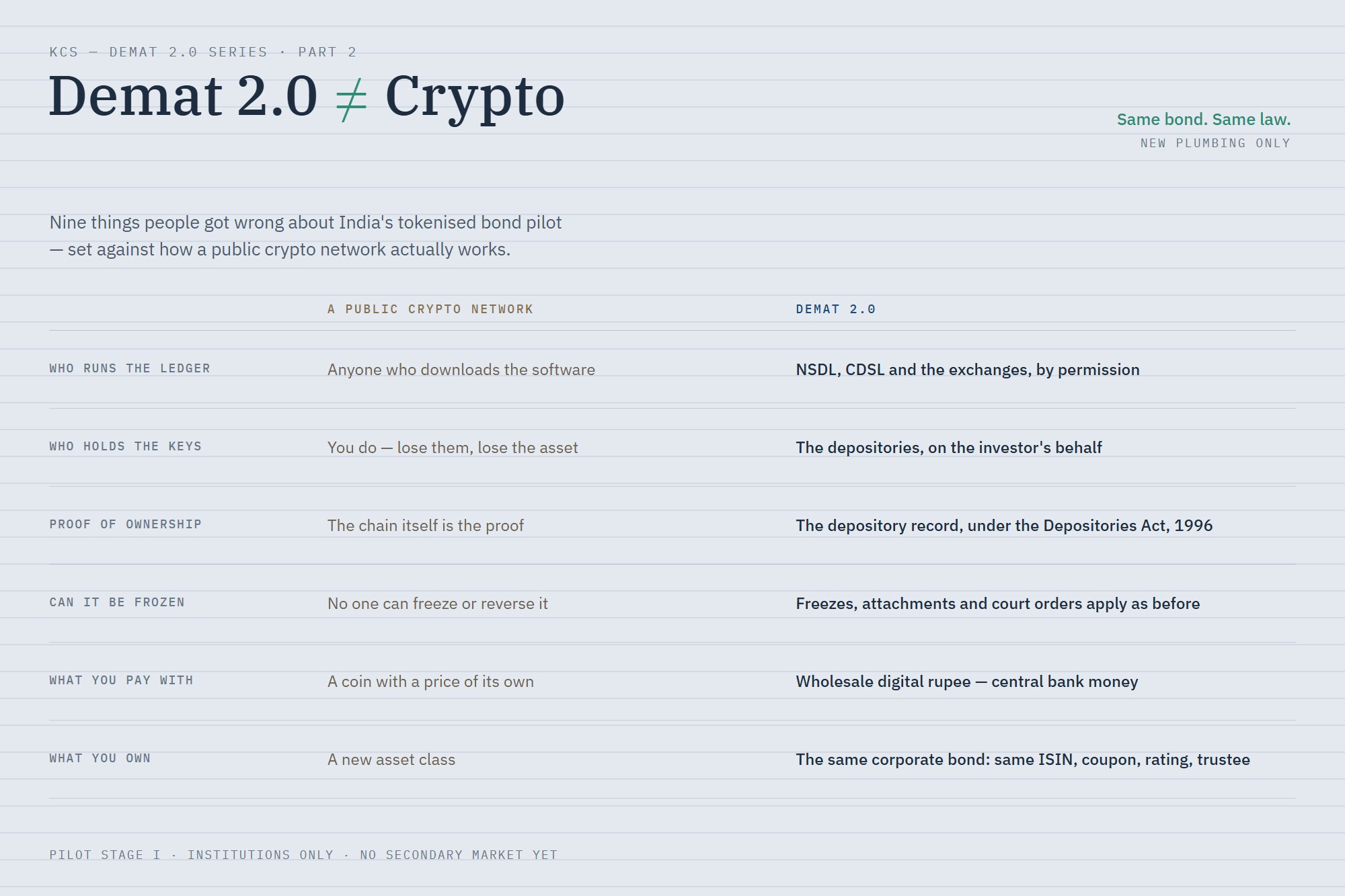
What’s actually true. There is no coin, no mining and no price of its own. A token here is a record of a specific corporate bond — the same bond, with the same ISIN, coupon and maturity date as before. Its value is the bond’s value. You cannot buy “a Demat 2.0 token” the way you might buy Bitcoin, because a token is only ever a particular bond belonging to a particular investor. (Confirmed)
2“It runs on a public blockchain”
What’s actually true. The ledger is permissioned. That means only approved institutions run it: the depositories NSDL and CDSL, with the exchanges also operating nodes initially, and NPCI providing technology support. Nobody can join the network by downloading software, and there is nothing to mine. A public blockchain is open to anyone; this is the opposite arrangement. (Confirmed)
3“It’s a new kind of security”
What’s actually true. Tokenising does not create a new class of instrument. The bond keeps its credit rating, its debenture trustee, its listing and disclosure obligations, and its place under the Depositories Act, 1996. What changes is how the holding is recorded and how payment settles, not what the investor owns. (Confirmed)
4“I’ll need to open a new demat account”
What’s actually true. A Demat 2.0 account is described as an extension of the existing demat account, with the same KYC and no fresh account-opening process. What is genuinely new is on the money side: taking part also requires a wholesale digital rupee wallet, opened through a participating bank and linked to the demat account with consent. (Confirmed)
5“I’ll have to look after private keys”
What’s actually true. Investors hold no cryptographic material at all. According to SEBI’s FAQs as reported, the depositories hold and manage the private keys on investors’ behalf, so nobody has to keep a seed phrase safe or run special infrastructure. This is the single biggest break from how crypto custody normally works, and it looks deliberate: no lost-wallet risk, and no claim of ownership that sits outside Indian securities law. (Confirmed, from FAQs as reported)
6“Anyone can buy these bonds now”
What’s actually true. Stage I is effectively institutional. A participant needs both a Demat 2.0 account and a digital rupee wallet, which rules out retail investors for the moment. Retail access is expected at Stage II, but no date has been confirmed. (Confirmed for Stage I; Stage II timing is unconfirmed)
7“They’re listed, so they must be trading”
What’s actually true. Listing is not the same as a trading venue. There is no secondary market for these bonds yet. As a stopgap, transfers between two demat accounts are permitted, but that is a manual arrangement, not a market. Telling detail: the pilot bonds priced in line with conventional bonds, because no market mechanism exists yet to price them differently. (Confirmed)
When trading does arrive, it is planned to run through the RFQ and OTC platforms that NSE and BSE already operate. SEBI has not proposed a separate “token exchange”. (Confirmed)
8“This replaces demat, or replaces NSDL and CDSL”
What’s actually true. The depositories are the ones running it. The depository’s own record remains the authoritative record of who owns the bond, and the token is another way of recording the same legal fact. Ordinary demat accounts carry on exactly as before. (Confirmed)
9“The digital rupee here is the app on my phone”
What’s actually true. There are two different digital rupees. The retail one (e₹-R) is the wallet app some banks offer to individuals. Demat 2.0 uses the wholesale digital rupee (e₹-W), which banks and financial institutions have used since 2022 for market settlement. They share a name and very little else. (Confirmed)
And one that comes up constantly: “so crypto is being allowed in”
What’s actually true. Nothing in this pilot changes India’s position on crypto assets. Corporate bonds are regulated securities and stay regulated securities. Because the depositories keep the legal record, existing controls carry over unchanged — a freeze, an attachment or a court order on a demat account applies to the tokenised holding automatically, with no new law needed. On a public chain, that is precisely what nobody can do. (Confirmed)
So what does change?
Stripping out the confusion leaves a short and fairly technical list.
The bond and the payment now settle together, as one event. Until now the securities leg moved on the depository’s own cycle while the money moved separately through the banking system; under the pilot, either both legs move or neither does. Because of that, issuers get their funds the same day instead of waiting the usual two to three days.
Coupon and redemption payments can also run on their own, with the bond’s terms held in a smart contract that pays into digital rupee wallets. And the holding gains a second way of being recorded — though the depository’s record still governs, exactly as it did before.
That is the whole of it. It is plumbing work: useful, unglamorous, and a long way from what the headlines suggested.
Our reading: the conservative choices here — permissioned ledger, depositories holding keys, existing law untouched — are what make the pilot likely to survive contact with the real market. They are also why it will feel, to most people, as though nothing happened at all.
Coming next in this series
- Demat 2.0 Explained
- Demat 2.0 Is Not Crypto (this article)
- How a Bond Becomes a Token (and Why the Law Stays the Same)
- Who Holds the Keys? Custody Under Demat 2.0
Later in the series: the digital rupee side, same-day settlement compared with today, whether these bonds can be traded yet, and a regularly updated Demat 2.0 tracker and glossary.
The token is not the asset. It is a second way of writing down a fact the depository already records.
Sources: Business Standard — Sebi launches Demat 2.0 pilot · TaxGuru — Demat 2.0 pilot and FAQs · CryptoTimes — Depositories hold private keys, not investors · CryptoTimes — First tokenised corporate bonds go live, secondary market yet to open · Moneylife — 3 issuers raise ₹1,025 crore · Business Standard — Wholesale digital rupee pilot from 1 November 2022
About the author: KCS Engineering — Depository Participant back-office software and regulatory operations for banks and brokers.
Disclaimer: This article reflects KCS’s views and our interpretation of publicly available information on the SEBI–RBI Demat 2.0 pilot, including press coverage and FAQs as reported, as of 19 September 2026. Kalpataru Computer Services (KCS) is not a depository, Depository Participant, bank, or other authorized regulatory entity. Details may change as SEBI and RBI publish formal circulars; always refer to official material on sebi.gov.in and rbi.org.in, which governs. This article is not legal, compliance or investment advice.
