

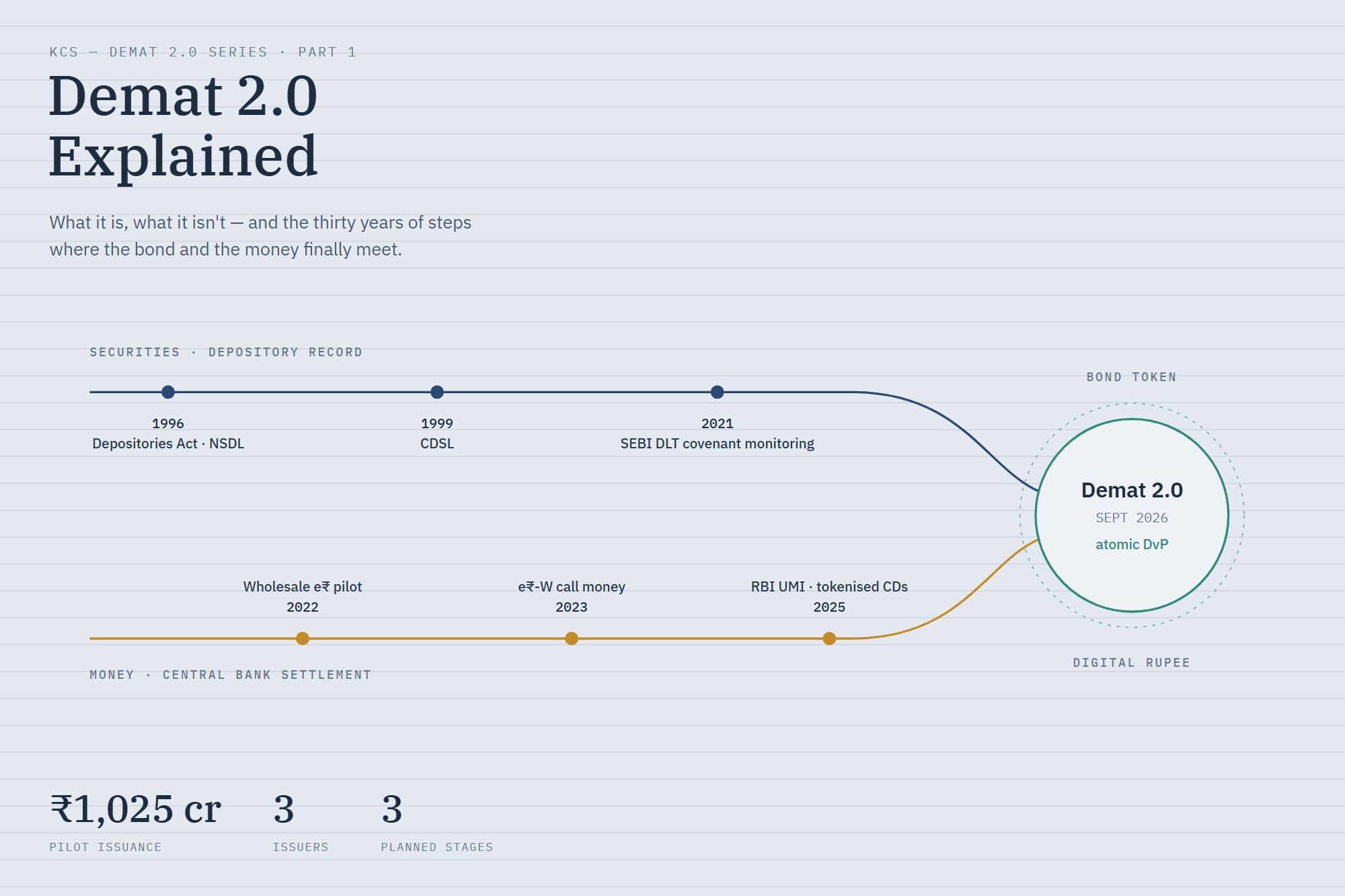
Part 1 of our Demat 2.0 series · Written as of 17 September 2026. This is a new pilot and details are still coming out, so we will update this page as they do.
In September 2026, SEBI and the Reserve Bank of India (RBI) launched a pilot called Demat 2.0. It is a new way to issue, hold and settle corporate bonds. The bond is recorded as a token on a shared ledger, and it is paid for in the digital rupee.
The name has caused some confusion. Some headlines made it sound like crypto, or like a replacement for your demat account. It is neither. This article covers the basics: what was announced, how India got here, and what is and isn’t changing. Later articles in the series go into each part in more detail.
What was announced
The pilot was announced on 10 September 2026 at the Global Fintech Fest in Mumbai, by RBI Governor Sanjay Malhotra and SEBI Chairman Tuhin Kanta Pandey. The first bonds were issued in the days just before the announcement.
| Issuer | Amount | Coupon | Date |
|---|---|---|---|
| REC Limited | ₹500 crore | 7.30% | 7 Sept 2026 |
| Larsen & Toubro | ₹500 crore | 7.40% | 9 Sept 2026 |
| IIFL Finance | ₹25 crore | 9.10% | 9 Sept 2026 |
That makes ₹1,025 crore in total. For scale, India’s corporate bond market is often quoted at around ₹52 lakh crore, so this is a small, controlled test.
In simple terms, the pilot puts three things together:
- A tokenised bond. The bond is recorded as a token on a distributed ledger (DLT). That is a shared database kept in sync across a few known institutions. It is not a public blockchain.
- Payment in central bank money. Buyers pay in RBI’s wholesale digital rupee (e₹-W), which is meant for banks and financial institutions, not for everyday retail use.
- Smart contracts. Small programs that carry the bond’s terms, so coupon and redemption payments can run on their own.
The bond and the money move together in one step. Either both settle or neither does. This is called atomic delivery-versus-payment, and it is why issuers could receive funds on the same day.
How we got here
Demat 2.0 did not arrive out of nowhere. It builds on several earlier steps.
| Year | Step | Why it matters |
|---|---|---|
| 1996 | The Depositories Act is passed. NSDL starts operations. | Shares and bonds can now be held electronically instead of as paper certificates. This is “Demat 1.0”. |
| 1999 | CDSL starts operations. | India has two depositories, which is still the case today. |
| Aug 2021 | SEBI requires DLT for security and covenant monitoring of listed debentures. | Depositories and debenture trustees first use a shared ledger for bonds. At this point it records the assets that back a bond, not the bond itself. |
| Nov 2022 | RBI starts its wholesale digital rupee (e₹-W) pilot, first for government securities trades between banks. | Central bank money becomes available in digital form for market settlement. |
| Oct 2025 | RBI announces the Unified Markets Interface (UMI) at Global Fintech Fest, with a pilot for tokenised certificates of deposit. | This creates the link between tokenised assets and digital rupee settlement. |
| Sept 2026 | SEBI and RBI launch the Demat 2.0 pilot for corporate bonds. | All the earlier pieces come together for listed corporate bonds. |
Looking at the timeline, each step solved one small problem. Paper became electronic records. Bond collateral went onto a shared ledger. Money became digital. Then a bridge joined the two. Demat 2.0 is the point where those steps connect.
What Demat 2.0 is — and what it isn’t
This is where most of the confusion sits.
| It is | It is not |
|---|---|
| A pilot under SEBI’s regulatory sandbox, with limited scope and time | A permanent, market-wide rule (not yet) |
| Corporate bonds recorded as tokens on a permissioned ledger run by market institutions | Crypto, or a public blockchain anyone can join |
| The same bond: same ISIN, coupon, maturity, rating, trustee and investor rights | A new kind of security or a new asset class |
| An extension of your existing demat account, using the same KYC | A new account you have to open from scratch |
| Keys managed by the depositories for investors | A wallet where you manage your own private keys |
| Open mainly to institutions at this stage | Something retail investors can buy into today |
| Primary issuance, with secondary trading planned for later | A live trading market (not yet) |
Two points are worth repeating. First, the depository’s record is still the legal record of who owns the bond. The token reflects that record; it does not replace it. Second, existing rules still apply. Credit ratings, debenture trustee duties, listing and disclosure norms, and freezes or attachments on a demat account all carry over.
What investors and issuers actually need
To take part at this stage, an investor needs:
- a Demat 2.0 account, which is an extension of their existing demat account, and
- a wholesale digital rupee wallet opened through a participating bank and linked to that demat account with consent.
Issuers need a digital rupee wallet to receive funds. Bids are still placed on the existing Electronic Bidding Platform (EBP), the same way as for any privately placed bond. The ledger and digital rupee come into play only after allotment.
What comes next
SEBI has described three stages:
- Stage I (live now): tokenised issuance, mainly for institutions. Transfers between two demat accounts are allowed as a temporary option.
- Stage II (planned): secondary trading through existing RFQ and OTC platforms. SEBI has not proposed a separate “token exchange”. Retail participation is expected at this stage.
- Stage III (planned): access for more regulated entities, and possibly other instruments.
No dates have been confirmed for Stage II or Stage III. Some reports mention target months, but we have not seen those in any official material, so we are not repeating them here.
Our reading
Our view is that Demat 2.0 is less about bonds becoming “digital assets”. It is more about changing the plumbing under the same bonds: how the ownership record is kept, and how the payment moves with it. For most people, nothing changes today. For market institutions, the useful thing is to understand how it works before the later stages arrive.
Plenty of questions are still open, including how trading will prevent the same bond from being sold twice, how banks will match digital rupee payments to individual clients, and when the pilot might become regular regulation. We cover these in later articles.
Coming next in this series
- Demat 2.0, Explained (this article)
- Demat 2.0 Is Not Crypto: Clearing Up Common Confusions
- How a Bond Becomes a Token (and Why the Law Stays the Same)
- Who Holds the Keys? Custody Under Demat 2.0
Later in the series: the digital rupee side, same-day settlement compared with today, whether these bonds can be traded yet, and a regularly updated Demat 2.0 tracker and glossary.
Demat 2.0 doesn’t change what a bond is. It changes how the bond and its payment are recorded and settled.
Sources: Business Standard — Sebi launches Demat 2.0 pilot · MediaNama — What SEBI’s Demat 2.0 means · TaxGuru — Demat 2.0 pilot and FAQs · Moneylife — 3 issuers raise ₹1,025 crore · SEBI — Security and Covenant Monitoring using DLT (Aug 2021) · Business Standard — Wholesale digital rupee pilot from 1 November 2022 · Civilsdaily — RBI introduces UMI
About the author: KCS Engineering — Depository Participant back-office software and regulatory operations for banks and brokers.
Disclaimer: This article reflects KCS’s views and our interpretation of publicly available information on the SEBI–RBI Demat 2.0 pilot, including press coverage and FAQs as reported, as of 17 September 2026. Kalpataru Computer Services (KCS) is not a depository, Depository Participant, bank, or other authorized regulatory entity. Details may change as SEBI and RBI publish formal circulars; always refer to official material on sebi.gov.in and rbi.org.in, which governs. This article is not legal, compliance or investment advice.
